
Those who sign up for my newsletter receive my “200-Word Resurrection Witness.” It’s 200 words because for years I taught on The Defense of the Resurrection of Jesus to the students in the Master of Arts in Christian apologetics program at Talbot School of Theology and told them they should always have a short version of the argument. My “200-Word Resurrection Witness” ends with this question: “If Jesus wasn’t raised from the dead, then why would the first disciples die for what they knew was a lie?”
But do we have evidence that the disciples died for proclaiming they saw the resurrected Jesus? To answer this question, this post will examine three questions. First, did the disciples actually believe Jesus was raised from the dead? Second, did the disciples actively proclaim that Jesus was raised from the dead? And third, is there evidence that some of Jesus’ most famous disciples actually gave their lives for this proclamation?[1]
Did the Disciples Believe that Jesus Was Raised from the Dead?
The first disciples believed Jesus rose from the dead. After all, believing and preaching the resurrection of Jesus Christ is central to the truth of historic Christianity. Consider Paul’s words in 1 Corinthians 15:3-8:
For I delivered to you as of first importance what I also received: that Christ died for our sins in accordance with the Scriptures, that he was buried, that he was raised on the third day in accordance with the Scriptures, and that he appeared to Cephas, then to the twelve. Then he appeared to more than five hundred brothers at one time, most of whom are still alive, though some have fallen asleep. Then he appeared to James, then to all the apostles. Last of all, as to one untimely born, he appeared also to me.
Paul calls holding that Jesus died for our sins and was raised “of first importance.” By the way, it is important to note that most scholars, even skeptical ones, believe that Paul wrote 1 Corinthians in the mid 50s AD.[2]
Notice also that Paul wrote “what I also received.” In other words, what Paul wrote here was a creedal statement that was passed on to him prior to the mid 50s. But don’t take my word for it. Consider what scholar James G. D. Dunn wrote, “This tradition, we can be entirely confident, was formulated as tradition within months of Jesus’ death.”[3] Also, the skeptical scholar Gerd Lüdemann wrote: “We can assume that all the elements in the tradition [of 1 Corinthians 15:3-8] are to be dated to the first two years after the crucifixion of Jesus.”[4]
Skeptic Bart D. Ehrman is unequivocal: “Historians, of course, have no difficulty whatsoever speaking about the belief in Jesus’ resurrection, since this is a matter of public record. For it is a historical fact that some of Jesus’ followers came to believe that he had been raised from the dead soon after his execution. We know some of these believers by name; one of them, the apostle Paul, claims quite plainly to have seen Jesus alive after his death.”[5]
So the disciples believed Jesus died and was raised, and they didn’t keep this to themselves!
Did the Disciples Actively Proclaim that Jesus Was Raised from the Dead?
After Judas committed suicide, the disciples sought someone to replace him using the criteria in Acts 1:21: “So one of the men who have accompanied us during all the time that the Lord Jesus went in and out among us, beginning from the baptism of John until the day when he was taken up from us—one of these men must become with us a witness to his resurrection.” Notice that they required Judas’s replacement to be a witness to Jesus’ resurrection.
When Paul was on trial before his “Excellency the governor Felix” (Acts 23:26), he cried out “It is with respect to the resurrection of the dead that I am on trial before you this day” (Acts 24:21; see also 23:6). In Acts 17:31 when Paul was in Athens he said, “For he has set a day when he will judge the world with justice by the man he has appointed. He has given proof of this to all men by raising him from the dead.” Suffice it to say, the disciples were arrested and tried because they proclaimed Jesus’ resurrection from the dead. I’ve written a post on the disciples using evidence in witnessing here.
Is There Evidence that Some of Jesus’ Disciples Were Martyred Because They Proclaimed Jesus Rose from the Dead?
Let’s briefly review the martyrdoms of Peter, Paul, and James. To do this I need to explain the historical background.
First, we know that Christians were being tortured to death in large numbers very early. In A.D. 109, the Roman historian Tacitus chronicled what Nero did to the Christians after the Great Fire of Rome in A.D. 64:
Consequently, to get rid of the report [that Nero had set the city on fire], Nero fastened the guilt and inflicted the most exquisite tortures on a class hated for their abominations, called Christians by the populace. Christus, from whom the name had its origin, suffered the extreme penalty during the reign of Tiberius at the hands of one of our procurators, Pontius Pilatus, and a most mischievous superstition, thus checked for the moment, again broke out not only in Judaea, the first source of the evil, but even in Rome, where all things hideous and shameful from every part of the world find their centre and become popular. Accordingly, an arrest was first made of all who pleaded guilty; then, upon their information, an immense multitude was convicted, not so much of the crime of firing the city, as of hatred against mankind. Mockery of every sort was added to their deaths. Covered with the skins of beasts, they were torn by dogs and perished, or were nailed to crosses, or were doomed to the flames and burnt, to serve as a nightly illumination, when daylight had expired.[6]
So many Christians were being torturously killed no later than A.D. 64. Remember that Jesus was crucified in A.D. 30. Why did these early Christians allow themselves to be tortured to death if it wasn’t because they actually believed that Jesus was raised from the dead?
So very early the Christians began preaching that Jesus was raised. Even atheist Michael Martin in The Case Against Christianity agrees that it “is correct that the Resurrection was proclaimed by the early Christians.”[7]
Why else would they have maintained their proclamation that Jesus was raised? If Jesus wasn’t raised, they wouldn’t have been emboldened to die for Him. The second century satirist Lucian commented on their boldness in facing death:
These misguided creatures start with the general conviction that they are immortal for all time, which explains the contempt of death and voluntary self-devotion which are so common among them; and it was impressed upon them by their original lawgiver that they are all brothers, from the moment that they are converted, and deny the gods of Greece, and worship the crucified sage, and live after his laws.[8]
So what do we know? We know that not later than 35 years of Christ’s crucifixion that many Christians confessed to being Christians even though it sometimes resulted in their torturous deaths. What they believed and preached was that Jesus was raised from the dead.
Peter and Paul Were Martyred
Now, we come specifically to Peter and Paul. Clement, a contemporary of the apostles (see Philippians 4:3) put it this way:
Let us come to those champions who lived nearest to our time. Let us set before us the noble examples which belong to our generation. By reason of jealousy and envy the greatest and most righteous pillars of the Church were persecuted, and contended even unto death. Let us set before our eyes the good Apostles. There was Peter who by reason of unrighteous jealousy endured not one but many labors, and thus having borne his testimony [martyresas] went to his appointed place of glory. By reason of jealousy and strife Paul by his example pointed out the prize of patient endurance. After that he had been seven times in bonds, had been driven into exile, had been stoned, had preached in the East and in the West, he won the noble renown which was the reward of his faith, having taught righteousness unto the whole world and having reached the farthest bounds of the West; and when he had borne his testimony before the rulers, so he departed from the world and went unto the holy place, having been found a notable pattern of patient endurance. Unto these men of holy lives was gathered a vast multitude of the elect, who through many indignities and tortures, being the victims of jealousy, set a brave example among ourselves.[9]
So we learn from a contemporary of the apostles that Peter was martyred and Paul was tortured (more on his martyrdom shortly) and that their testimony encouraged those who heard them to likewise endure torture and death.
Polycarp, another contemporary of the apostles and a disciple of the apostle John (Polycarp was himself burned at the stake in 155), wrote:
Now I beseech you all to obey the word of righteousness, and to endure with all the endurance which you also saw before your eyes, not only in the blessed Ignatius, and Zosimus, and Rufus, but also in others among yourselves, and in Paul himself, and in the other Apostles; being persuaded that all of these “ran not in vain,” but in faith and righteousness, and that they are with the Lord in the “place which is their due,” with whom they also suffered. For they did not “love this present world” but him who died on our behalf, and was raised by God for our sakes.[10]
Notice that Polycarp related Paul’s suffering to Jesus’ resurrection. Around 200 Tertullian wrote:
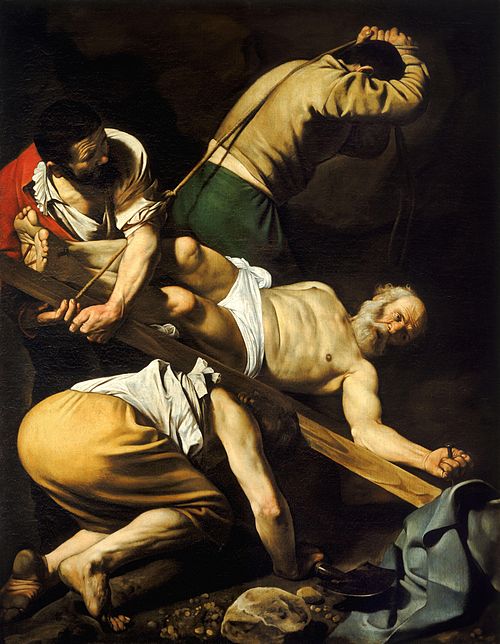
That Paul is beheaded has been written in their own blood. And if a heretic wishes his confidence to rest upon a public record, the archives of the empire will speak, as would the stones of Jerusalem. We read the lives of the Caesars: At Rome Nero was the first who stained with blood the rising faith….Then does Paul obtain a birth suited to a Roman citizenship, when in Rome he springs to live again ennobled by martyrdom. Then is Peter girt by another, when he is made fast to the cross.[11]
Here Tertullian says, if you don’t believe me, check out “the archives of the empire”! We may not have those archives today but only those who don’t want this to be true could argue that Tertullian was just making that up.
Similarly, the church historian Eusebius (236-339) points to additional evidence:
Thus [Nero] publicly announcing himself as the first among God’s chief enemies, he was led on to the slaughter of the apostles. It is, therefore, recorded that Paul was beheaded in Rome itself, and that Peter likewise was crucified under Nero. This account of Peter and Paul is substantiated by the fact that their names are preserved in the cemeteries of that place even to the present day.[12]
Here Eusebius tells the reader to check out the cemetery where they were executed because at that time it still existed!
James Was Martyred
Then there is Jesus’ brother James. First Corinthians 3:7 tells us that Jesus appeared to his brother James. James later became a leader in the Christian church (Acts 15:13). The Jewish historian Josephus (37/38–100), in his Antiquities of the Jews (93 CE), wrote that the high priest Ananus “assembled the Sanhedrin of judges, and brought before them the brother of Jesus, who was called Christ, whose name was James, and some others, and when he had formed an accusation against them as breakers of the law, he delivered them to be stoned….”[13] Consider how much evidence it would take for you to so believe that your brother was raised from the dead that you’d be willing to die for him.
This isn’t the place to present further evidence for the martyrdom of Peter, Paul, and James, but anyone who wishes for more can see Sean McDowell’s excellent book, The Fate of the Apostles: Examining the Martyrdom Accounts of the Closest Followers of Jesus (affiliate link).[14]
I’ll bring this verse up again, Acts 17:31: “For he has set a day when he will judge the world with justice by the man he has appointed. He has given proof of this to all men by raising him from the dead.”
Amen.
[1] There isn’t conclusive evidence that all of Jesus’ disciples were martyred.
[2] Bart D. Ehrman: “The earliest Christian writings that still survive are those of the apostle Paul, written around 50-60 CE.” Bart D. Ehrman, Truth and Fiction in The Da Vinci Code (Oxford: OUP, 2004), 77-78. John Dominic Crossan says 1 Cor. “Written from Ephesus in the winter of 53-54 C.E…..” John Dominic Crossan, The Historical Jesus: The life of a Mediterranean Jewish Peasant (New York: HarperCollins, 1991), 427.
[3] James G. D. Dunn, Jesus Remembered: Christianity in the Making (Grand Rapids, MI: Eerdmans, 2003), 855. Emphasis his.
[4] Gerd Lüdemann, Resurrection of Jesus: History, Experience, Theology (Philadelphia: Fortress Press, 1995), 38.
[5] Bart D. Ehrman, Jesus: Apocalyptic Prophet of the New Millennium (Oxford: OUP, 2001) 231. Emphasis mine.
[6] Tacitus, The Annals, http://classics.mit.edu/Tacitus/annals.11.xv.html.
[7] Michael Martin, The Case Against Christianity (Philadelphia: Temple University, 1991), 90.
[8] Lucian, The Death of Peregrine, http://www.sacred-texts.com/cla/luc/wl4/wl420.htm.
[9] 1Clement 5:1-6:2, http://www.earlychristianwritings.com/text/1clement-lightfoot.html. It’s true that Clement says that Paul “departed” this world but Clement does so in the context of Paul’s suffering persecution and having set a “notable pattern of patient endurance.” At the very least this suggests his martyrdom. Also, in 2 Timothy 4:6-8 it is clear that while in prison Paul expects his own death: “For I am already being poured out as a drink offering, and the time of my departure has come. I have fought the good fight, I have finished the race, I have kept the faith. Henceforth there is laid up for me the crown of righteousness, which the Lord, the righteous judge, will award to me on that day, and not only to me but also to all who have loved his appearing.” The being “poured out at a drink offering” is similar to the pouring out of blood in Old Testament sacrifice (Leviticus 16:15-20).
[10] Polycarp, Philippians 9:1-2, http://www.earlychristianwritings.com/text/polycarp-lake.html.
[11] Tertullian, Scorpiace XV, http://www.ccel.org/ccel/schaff/anf03.v.x.xv.html. Also, regarding Peter Ignatius of Antioch (c.35-108), who himself was sentenced to be killed by lions in the arena, wrote: “For I know and believe that He was in the flesh even after the resurrection. And when He came to Peter and those who were with him, He said to them, ‘Take, handle me and see that I am not a spirit without body.’ And straightway they touched Him and believed, being united with His flesh and spirit. Therefore also they despised death, and were found to rise above death.” Ignatius, The Epistle to the Smyrneans. http://www.earlychristianwritings.com/srawley/smyrnaeans.html. It is true that these comments by Ignatius don’t specifically say that they were killed for their faith but at the very least it says that they were willing to die for their faith.
[12] Eusebius, History of the Christian Church, 2.XXV.5. http://www.ccel.org/ccel/schaff/npnf201.iii.vii.xxvi.html.
[13] Flavius Josephus, Jewish Antiquities, XX.8.1. The New Complete Works of Josephus, William Whiston, trans., (Grand Rapids, MI: Kregel, 1999), 656.
[14] Sean McDowell, The Fate of the Apostles: Examining the Martyrdom Accounts of the Closest Followers of Jesus (Burlington, VT: Ashgate, 2015), 91.