
Over the years I’ve learned that many Christians believe that there are many good non-Christians After all, if you actually know some good non-Christians, then there must be good non-Christians, right?
That’s not what Jesus thought and that humans outside of Christ aren’t good is the second most untaught doctrine in American Christianity (second only to the glory of eternal life which I discussed in my last post). Consider that Jesus wasn’t making small talk, just passing the time of day, when He was called a “good teacher” but replied, “Why do you call me good? No one is good except God alone.”[1] Now it is true there are outwardly good non-Christians—there are many of them—but we must not confuse outward goodness with inward goodness. For Jesus, evil is always, first and foremost, a matter of the heart. And, by the way, both Calvin and Arminius agreed that apart from the work of the Holy Spirit, no one does anything good. Still, Christians wonder: Is it possible for a person to be a good person outside of a relationship to Christ?
At the outset, it is important to point out that I’m not even remotely suggesting that Christians don’t sin. They do, often, and sometimes grievously.[2] Of course Christians sin! I do! But true Christians—those who have been born again, those who have been filled with the Holy Spirit—are changed from within. They become “obedient from the heart” and “slaves of righteousness” (Roman 6:17-18). They will not go on living in sin. I did a post two weeks ago entitled, You Probably Aren’t Saved If…, where I pointed out that true Christians will not go on living in sin. In other words, the Christian’s inner person wants to do God’s will even though they may often choose not to.[3] So let’s look at human “goodness” apart from Christ.
Why Do Bad People Do Good Things?
I’ve asked my students, “Why do gangbangers stop at red lights?” I mean, it’s not like gangbangers are thinking, I don’t care for any other law, but I do respect red light laws! So why do gangbangers stop at red lights? A student once asked meekly, “Because they don’t want to get a ticket?” Yes, of course, that might be part of it. But isn’t there a bigger reason, a more compelling one? Isn’t the real reason gangbangers stop at red lights because they don’t want to be hit by an 18-wheeler and turned into red asphalt? Sure it is. In other words, the reason gangbangers stop at red lights is self-interest. They don’t stop out of moral goodness.
Jesus said that one who lusts has committed adultery in his or her heart.[4] Now consider a scenario in which a man and a woman are both working at the same company and they are both married to people outside that company. And in time, he begins to flirt with her, and she begins to flirt with him. Soon they’re both having sexual fantasies about each other, and both are beginning to think that perhaps the other person would be willing to have sex with them. When that’s the case, why don’t they go all the way and do the deed?
Well, it’s not because they have decided to cherish only their spouse, right? So why don’t they “do it”? Isn’t it because they’re afraid that she might get pregnant? Or they’re afraid that one of them might bring home an STD (“Oh, that’s new honey, where did you get that?”). Or they’re afraid that if their adultery became public knowledge that they might lose their jobs, or their family, or their reputations? Or all of the above?
Whatever the case, notice that the reason they aren’t “doing it” isn’t because of moral goodness. Rather, it’s because of self-interest. And when people in this situation finally go ahead and “do it,” it’s because they’ve decided that they have workarounds for all the potential problems (“We’ll use a condom,” “Our spouses are away,” “She/he will never tell,” and so on).
We may think those who restrict their adultery to their minds are good, but they’re not. The world is full of such “good people.” Ultimately, evil is a matter of the heart.
The apostle John wrote, “He who hates his brother is a murderer.”[5] In other words, if you hate someone, you are a murderer even if you don’t actually kill that person. Why don’t you kill the person you hate? It’s not because you care for the person, right? After all, we’ve already established your hate them. Then isn’t it about self-interest? “I don’t want to live in a cell and I’ve seen those guys/gals in the prison population, and I couldn’t pump enough iron to protect myself!”[6] And, as with adultery, when haters actually kill, it is because they have become convinced, rightly or wrongly, that they can get away with it.
That being the case, how many of us got out of junior high without being adulterous murderers? I didn’t. I hated kids, and kids hated me. And I don’t think I need to explain to you the adulterous part of a junior high school boy’s mind (see my post A Sure-Fire Way to Stop Looking at Porn). Thus we live in a society of adulterous murderers who think they are good non-Christians because they aren’t acting out their sinful desires due to self-interest.
With these truths in view, perhaps Scripture makes more sense when it says in Romans 3, “There is no one who does good, not even one. Their throats are open graves…Their mouths are full of cursing…Their feet are swift to shed blood.”[7] Now sometimes people object that the Bible points to other people as being “good.” But we must let all of Scripture inform our understanding of this matter and, as has been pointed out, Romans 3:23 clearly states that “all have sinned and fall short of the glory of God” (NIV). Later in Romans 4:2-3 we read that Abraham was righteous, but that righteousness was based on his faith, not because he wasn’t a sinner: “For if Abraham was justified by works, he has something to boast about, but not before God. For what does the Scripture say? ‘Abraham believed God, and it was counted to him as righteousness.’”
Thus we can be sure that Old Testament saints who were called righteous were so designated because of their faith (Hebrews 11), and their faith led them to live in conformity with God’s will.
Was Ghandi a Good Non-Christian?
Many people bring up specific examples of “good” humans: “Okay, but what about grandma? Sure she isn’t a Christian, but she volunteers at the community center and she makes chocolate chip cookies for the kids on her street. Isn’t she a good person?” But that doesn’t make her a good person—it only makes her a nice person. After all, we can be certain there are some KKK grandmas who help white seniors and bake chocolate chip cookies for the white kids in their neighborhoods. Sure they are. That doesn’t make them good.
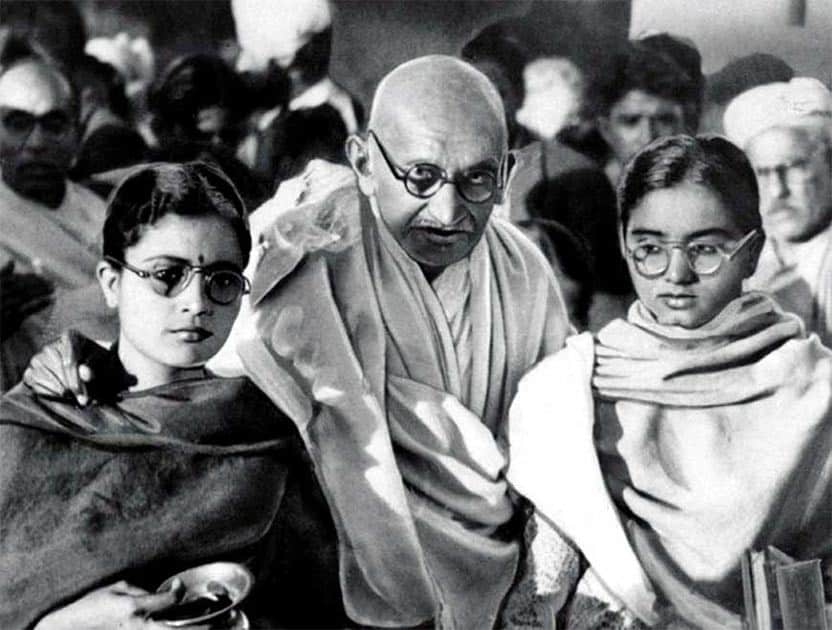
Gandhi is most often cited as an example of the “good” non-Christian. But Gandhi wasn’t good. Again, doing a good deed—or even a lot of good deeds—doesn’t make someone a good person. Gandhi may have done many good things, but every night he went to bed naked with his two nieces, other girls (often at the same time), and even married women (one of them married to his grandnephew). He said he did this to test his resistance.[8] It isn’t clear how often his resistance held firm.
Niceness isn’t goodness. Lending money or possessions to those who lend to us, smiling at neighbors, and baking cookies doesn’t make one good. One horrifying realization about murderers is that they can otherwise be nice. Adolph Eichmann, the administrator at Auschwitz, was a family man who never killed anyone himself;[9] Pol Pot, who orchestrated the killing fields of Cambodia, had a warm smile.[10] When serial killers are caught, their neighbors are often surprised and testify that the killers were nice, even helpful, to those around them. As C.S. Lewis put it, “Everyone feels benevolent if nothing happens to be annoying him at the moment.”[11]
Thus Jesus said, “If you love those who love you, what credit is that to you? Even sinners love those who love them. And if you do good to those who are good to you, what credit is that to you? Even sinners do that. And if you lend to those from whom you expect repayment, what credit is that to you? Even sinners lend to sinners, expecting to be repaid in full.”[12]
Many misunderstand the Jewish religious leaders of Jesus’ day, the Pharisees: They were outwardly good people. But Jesus called them whitewashed tombs, blind guides, vipers. Outwardly they looked good, but inwardly they were “full of dead people’s bones.”[13] And, contrary to popular belief, Jesus never criticized them for condemning sin; He criticized them for doing what they condemned—the leaven of the Pharisees was hypocrisy.[14] In other words, the chief characteristic of the Pharisees was that they didn’t live what they said they lived. Similarly, there are many in today’s churches who are regular attenders, givers, and greeters, but they unrepentantly harbor hate and lust in their hearts.
Why Non-Christians Do Good
I’m often asked about heroic acts that do appear to be examples of human goodness, but, again, doing one good act or even many good acts doesn’t make one a good person. It just makes one the doer of some good acts. But there’s more to be said about heroism. Ernest Becker, in his Pulitzer Prize-winning book The Denial of Death, argues successfully that man’s overarching fear, the mainspring of his existence, is that he knows he is going to die. To cope with this, as the author of the foreword sums it up, man tries to “transcend death by participating in something of lasting worth. We achieve ersatz immortality by sacrificing ourselves to conquer an empire, to build a temple, to write a book, to establish a family, to accumulate a fortune, to further progress and prosperity, to create an information society and a global free market.”[15]
Becker further writes that a fellow who may “throw himself on a grenade to save his comrades” must “feel and believe what he is doing is truly heroic, timeless, and supremely meaningful,” and says this striving for heroics in “passionate people” is “a screaming for glory as uncritical and reflexive as the howling of a dog.”[16] But for most people—for the more “passive masses”—this heroism is “disguised as they humbly and complainingly follow out the roles that society provides for their heroics and try to earn their promotions within the system” that allows them to “stick out, but ever so little and so safely.”[17] Becker, who openly rejects Christianity, further attests to what Scripture teaches: “There is no one who does good” (Romans 3:12 NIV).
Something is desperately wrong with humankind, and the best explanation is original sin—we are all born in a corrupted state.[18] Here’s what the Bible says about the nature of the non-Christian—our nature before we were born again. Ephesians 2:1-3: “And you were dead in the trespasses and sins in which you once walked, following the course of this world, following the prince of the power of the air, the spirit that is now at work in the sons of disobedience—among whom we all once lived in the passions of our flesh, carrying out the desires of the body and the mind, and were by nature children of wrath, like the rest of mankind.” Notice that outside of Christ, Satan is at work within you and you are “by nature children of wrath.” But the very next verse, Ephesians 2:4 tells us, “But because of his great love for us, God, who is rich in mercy, made us alive with Christ even when we were dead in transgressions—it is by grace you have been saved.” Indeed, you can be born again into a new family. Trust in Jesus’ work on the cross and repent of your sins. You’ll be saved and then you’ll become obedient from the heart.[19]
I can’t think of a more unpopular message than the one I’ve posted here. Many will be offended by my saying there are no good non-Christians. Indeed a student once sheepishly asked “Is this a message we really want to get out?” I replied, “Jesus said that ‘the reason the world hates me because I testify that its works are evil.’ So WWJD!” Isn’t this another way that we should be more like Jesus?
Adapted from, Why Does God Allow Evil?
[1] Mark 10:18.
[2] In my earlier conceptions of this book I was going to include a chapter on the Crusades, Inquisitions, witch-hunts, slavery, Nazi Christians, and the oppression of women, but decided not to as these are not traditional problem-of-evil issues. I teach on this in my class “Why God Allows Evil” because if Christians have the good news then why do they often appear to be such bad news for society? I do have two blog posts on this (more will follow). See “Crusades, Inquisitions, Witch-Hunts, etc.” See also “The Truth about the Crusades,” “Feminism Is Making Females Miserable.”
[3] I’ve found when I teach this that some Christians worry because they find themselves so often sinning. But the fact that they are worried about their sin shows that they have been born again. Before I was a Christian, I didn’t worry about sin: I only worried about being caught. To those who struggle with sin I say, “Take heart!” As Jesus said in Matthew 5:6, “Blessed are those who hunger and thirst for righteousness, for they shall be satisfied.”
[4] Matthew 5:28.
[5] 1 John 3:15.
[6] Someone might object that a hater might refrain from murder because that hater has a sense that murder is wrong. But why would it being “wrong” stop him? I suspect that if the hater’s vague sense of “wrong” were unpacked that it would amount to the same thing as “be illegal” or societally unacceptable, both of which would involve undesirable consequences for the hater to actually murder.
[7] Romans 3:12-15 NIV.
[8] Jad Adams, “Thrill of the Chaste: The Truth about Gandhi’s Sex Life,” The Independent, April 7, 2010, http://www.independent.co.uk/arts-entertainment/books/features/thrill-of-the-chaste-the-truth-about-gandhis-sex-life-1937411.html.
[9] See Hannah Arndt, Eichmann in Jerusalem: A Report on the Banality of Evil (New York: Penguin, 1994). Arndt reports, “According to his religious beliefs, which had not changed since the Nazi period (in Jerusalem Eichmann declared himself to be a Gottgläubiger, the Nazi term for those who had broken with Christianity, and he refused to take his oath on the Bible), this event was to be described to ‘a higher Bearer of Meaning,’ an entity somehow identical with the ‘movement of the universe,’ to which human life, in itself devoid of ‘higher meaning,’ is subject.” Ibid., 27. Arndt reports that at the gallows “he began by stating emphatically that he was a Gottgläubiger, to express in common Nazi fashion that he was no Christian and did not believe in life after death.” Ibid., 252.
[10] David Chandler writes: “Schoolmates remembered him as a mediocre student but pleasant company, a reputation that persisted among those who knew him in France. As a teacher, he was remembered as calm, self-assured, smooth featured…honest, and persuasive, even hypnotic when speaking to small groups…A man who met him in the late 1950s, for example, said, ‘I saw immediately that I could become his friend for life.’” David P. Chandler, Brother Number One: A Political Biography of Pol Pot (Boulder, CO: Westview, 1992),5.
[11] Lewis, Problem of Pain, 44.
[12] Luke 6:32-34 NIV.
[13] Matthew 23:27.
[14] Luke 12:1.
[15] Sam Keen, “Forward” in Ernest Becker, The Denial of Death (New York: Free Press, 1973), xiii.
[16] Becker, The Denial of Death, 6.
[17] Ibid.
[18] See chapter 2 for a fuller discussion on original sin.
Those are all valid Scriptural points you make. Another reason that non-Christians may appear good, though this does not justify them before God, may be found in Romans 2:14-15: “For when the Gentiles, which have not the law, do by nature the things contained in the law,these, having not the law, are a law unto themselves: Which shew the work of the law written in their hearts, their conscience also bearing them witness, and their thoughts the mean while accusing or else accusing or else excusing one another.”
It would appear that even “Gentiles” or non-Christians can be guided somewhat by their conscience to an extent as the law of God is again, to a certain extent, written in their hearts. So says Scripture.
I m not interested to delve into Gahdhi’s nicesness which the author had clearly
presented it to us. I want a clear understanding about what Matt 12:35 the ‘good man’ here is Jesus or Christian or a Pagan? as well as Gen 20:6 in what sense Abemelech is ‘righteous’ (Rom 2:14-15)?
Matthew 12:35 says, “A good man brings good things out of the good stored up in him, and an evil man brings evil things out of the evil stored up in him.” Jesus is talking about righteous Jews and Christians. In Genesis 20:6 it says, “Then God said to him in the dream, “Yes, I know that you have done this in the integrity of your heart, and it was I who kept you from sinning against me. Therefore I did not let you touch her.” Abimelech acted with integrity regarding Abraham’s wife. It doesn’t say he is a good person but when it came to the way Abimelech handled that situation he handled it with integrity (or righteousness). I didn’t say that a non-Christian cannot on occasion tell the truth, of course they can. But that doesn’t make them good people.
Pingback: mid-week apologetics booster (7-11-2024) – 1 Peter 4:12-16
I talk at length about why non-Christian do “good” in my book Immortal.